


Why a Green Industry Act?
First, two observations:
- France has undergone a massive process of deindustrialization. In fifty years, the country has lost some 2.5 million jobs in industry. Industry’s share of GDP halved from 22% to 11% over the same period.
- Industry accounts for around 18% of national greenhouse gas emissions, with a high concentration on a few dozen high-emitting sites. The 50 highest-emitting industrial sites alone account for 55% of industrial emissions (or around 11% of France’s total).
Faced with these two facts, and in order to guarantee France’s sovereignty, the public authorities wish to support the investment dynamic for a green industrial policy, which is where the Green Industry Act comes in.
-81%
Target reduction in greenhouse gas emissions from industry in 2050 (compared with 2015)
Source: French Ministry of the Economy, Finance and Industry
This Green Industry Act is part of the new European framework known as the NZIA (Net Zero Industry Act). It aims to respond to the Inflation Reduction Act (IRA) adopted by the United States in 2022 and the Chinese Five-Year Plan of late 2021, both designed to stimulate the development of their industrial sectors, particularly in decarbonized technologies.
What’s the point of a Green Industry Act?
The Green Industry Act was passed on October 24, 2023 with two major ambitions:
- The creation of green industries (batteries, hydrogen, CO2 capture, etc.).
- The decarbonization of existing industry, particularly at the highest-emission industrial sites.
The challenge is to reindustrialize and decarbonize the sector at the same time. More concretely, three main priorities have been defined to achieve these objectives.
- Facilitate, by speeding up administrative procedures and cleaning up brownfield sites.
The government’s flagship measure in this area consists of pre-developing and pre-equipping 50 industrial sites, i.e. some 2,000 hectares of available land. These sites will be decontaminated if they are brownfield sites. To this end, the Banque des Territoires will invest more than €1 billion over the period 2023-2027, including around €450 million for the creation of 50 new sites and around €600 million for decontamination.
In addition, public authorities are integrating a development objective for industrial activities at regional level via the Schéma Régionaux d’Aménagement, de Développement Durable et d’Egalité des Territoires (SRADDET).
Finally, the public authorities want to reduce the time taken to complete administrative procedures from the current 9 months in theory to 17 months in practice, to a maximum of 6 to 9 months. To further accelerate the establishment of industrial facilities, certain projects may also be declared to be of national interest. For example, decrees have been issued qualifying 5 industrial projects as “projects of major national interest”: a photovoltaic panel production plant (in Bouches-du-Rhône), a photovoltaic cell manufacturing plant (in Moselle), a lithium extraction and processing site (in Allier), a plastics recycling plant (in Seine Maritime) and a low-carbon iron ore production plant (in Bouches-du-Rhône).
- Financing green technologies and the decarbonization of existing industries.
To this end, a “Green Industry Investment” tax credit (known as “C3IV”) will be launched. This will benefit both tangible (land, buildings, equipment, machinery, etc.) and intangible (patents, licenses, intellectual property rights, etc.) industrial investments. The C3IV can cover between 20% and 45% of the investment. It is aimed at four key sectors: battery production (including components), solar panels, wind turbines and heat pumps. Other activities remain eligible for current support mechanisms: calls for projects, etc.
For the decarbonisation of existing industrial sites, two funding packages had already been announced:
- 5.6 billion euros, via Ademe, for the highest-emitting sites (which account for around 75% of industry’s greenhouse gas emissions).
- 2.3 billion euros per year, via BPI France, for other sites (which account for the remaining 25% of industrial emissions).
Finally, and this is one of the main new features introduced by the green industry bill, the public authorities have created a specific savings product: the Plan Epargne Avenir Climat (PEAC). Available since July 1, 2024, the PEAC is reserved exclusively for young people under the age of 21, enabling them to invest in a variety of vehicles (equities, bonds, etc.) up to a limit of 22,950 euros. Please note that, unlike regulated savings passbooks (such as the Livret A), PEAC capital is not guaranteed. However, gains and capital gains are not subject to income tax or social security contributions. Note that the funds invested are blocked for a minimum period of 5 years, and the PEAC will be automatically closed at the age of 30.
In addition, since October 10, 2024, every life insurer has been required to offer at least one life insurance product incorporating unlisted assets for investment in the green industry.
5 billion euros
Estimated additional annual financing via new dedicated savings products
Source: French Ministry of the Economy, Finance and Industry
- Encourage virtuous companies with a label, condition public aid and guide public procurement.
In this field, the public authorities are considering the creation of a new label: the Triple E standard (European Environmental Excellence), which would bring together the best existing environmental systems under this banner.
Above all, while public procurement represents over 150 billion euros a year, less than 20% of public contracts incorporate environmental considerations. Thanks to the French “green industry” law, the public authorities are determined to increase this proportion, although no quantified target has yet been defined.
Is there any momentum for reindustrialization in France today?
To measure the momentum of reindustrialization in France brought about by the Green Industry Act, the public authorities recently launched the “State Industrial Barometer”. Every six months, this document lists the openings and closures of industrial sites in France. Please note, however, that this barometer also includes significant reductions and extensions to existing sites.
Half-yearly results of the French government’s industrial barometer
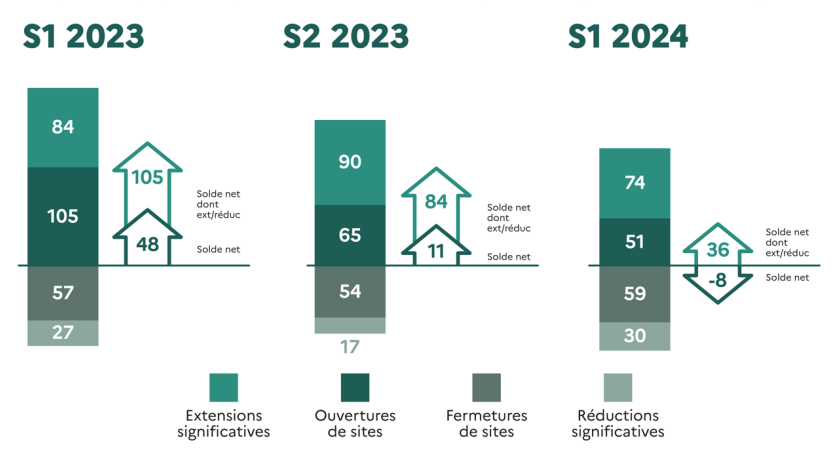
As we can see, it is difficult to speak of a reindustrialization dynamic in France at present. Firstly, the net balance (including site reductions/extensions) is falling sharply: 105 sites in H1 2023, 84 in H2 2023 and 36 sites in H1 2024.
Excluding reductions/expansions of existing sites, the net balance became negative in the first half of 2024 (-8 sites). In the first six months of the year, 59 sites were closed, compared with 51 industrial sites created.
However, among the latter, the green industry takes the lion’s share (see box opposite), with 21 site openings and only 4 closures.
Within the “green industry” classification, 60% of industrial sites concern decarbonized technologies (batteries, photovoltaic solar power, heat pumps, wind power and hydrogen). The balance comes from activities linked to soft mobility (bicycles and electric vehicles), recycling and waste reuse.
Conversely, the sectors that consume the most energy are the hardest hit, such as the automotive and plastics industries.
47%
The share of green industry in the number of net industrial site openings in the 1st half of 2024 (17 out of 36 in total)
Source: French Ministry of the Economy, Finance and Industry
Administrative simplification, creation of new sites, financial support… the public authorities have stepped up initiatives to stimulate the country’s reindustrialization under the Green Industry Act.
But beyond these various measures, the question of energy prices, and therefore the energy bills of industrial companies, is a key factor in the competitiveness of future projects.
A European initiative on energy prices for the competitiveness of European industry is expected in 2025.
Talk to an expert
Error: Contact form not found.